Content Systems
LiveThe Two-Tier SEO Content Pipeline: From Keyword Research to Scheduled Drafts
Five purpose-built Claude skills and two scheduled tasks run SEAR's blog — planning separated from writing, with human gates at every publish decision.
Last updated · Tools: Claude (Cowork) skills, Google Search Console MCP, WordPress MCP, BigQuery, Scheduled tasks
The problem
SEAR competes on education: surfers search for surfer's ear, swimmers search for swimmer's ear, and the brands that answer those questions well earn the traffic and the trust. Consistent SEO content requires a chain of work — research, planning, competitor reading, drafting, on-page optimisation, publishing — that a two-person team with full-time jobs cannot sustain manually. And because the topics are health-adjacent, "just let AI publish" was never an option.
The previous manual process
A single post took a full weekend afternoon, and there was no planning layer at all — topics were picked ad hoc, which meant no seasonality, no coverage strategy, and eventually posts competing with each other for the same keyword.
The AI-assisted workflow
The system is five reusable Claude skills orchestrated by scheduled tasks, with planning deliberately separated from writing:
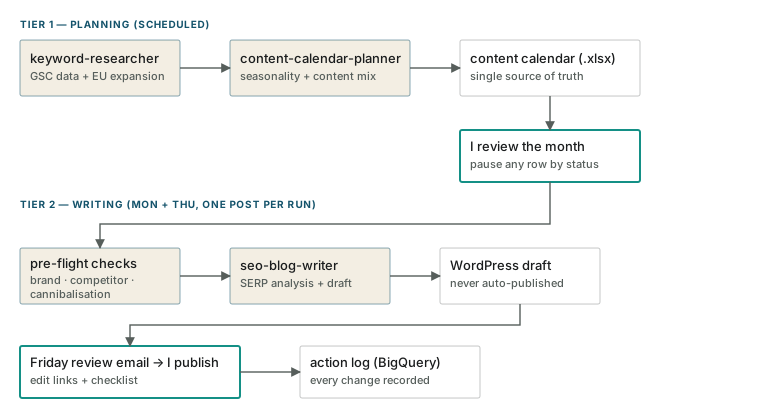
The whole pipeline is wired together by three MCP connections into Claude: the Google Search Console MCP (the ranking and impressions baseline), the WordPress MCP (reads the live site and creates drafts), and a BigQuery MCP (the append-only action log). Naming them matters — the pipeline is only trustworthy because every step reads and writes through a real, auditable connection rather than a model's guess about the site's state.
Tier 1 — planning (scheduled). A planning run invokes keyword-researcher, which pulls the real baseline through the Google Search Console MCP (opportunity finder, position tracking, cannibalisation checks), expands seeds through autosuggest, People-Also-Ask and forum language, runs a mandatory EU-language expansion (DE/ES/FR/PT/NL — because EU shipping is a commercial priority the organic traffic didn't reflect), and analyses competitor content for gaps. Then content-calendar-planner maps the surviving keywords onto publish dates using a water-sports seasonality table and content-mix rules, and writes everything into one spreadsheet — content-calendar-active.xlsx — which is the single source of truth for the whole system.
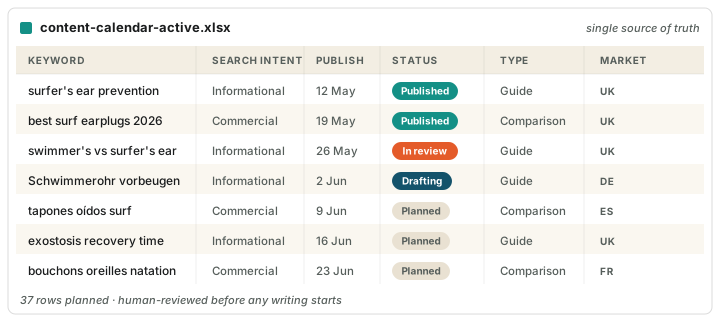
Human gate #1: I review the entire month's calendar before any writing starts, and I can pause any post by changing one status cell.
Tier 2 — writing (Monday and Thursday, 08:00). A scheduled task reads the calendar, picks exactly one row due for writing, and runs pre-flight checks before a word is drafted: brand-rule check, competitor check, and a live cannibalisation check through the Google Search Console MCP. Then seo-blog-writer analyses the current SERP, writes 1,200–2,000 words in SEAR's voice with FAQ sections built from real search questions, adds internal links preferring pages ranking at positions 8–20 (where a link boost matters most), and creates a draft in WordPress through the WordPress MCP — meta title and description in place.
Human gate #2: every Friday at 09:00, a review task emails me the week's drafts with edit links and a publishing checklist. Publishing is always my click.
Every action along the way is logged through the BigQuery MCP to an append-only table — no change happens that isn't recorded.
Human review required
Three layers, by design: the monthly calendar review, the Friday pre-publish review, and a hard rule that medical-adjacent content (maximum one slot per month) carries a review marker and never ships without human eyes. Health topics are why this system drafts more than it publishes.
Outcome
The real win is consistency. Before this pipeline, a post took a full weekend afternoon and happened whenever there was time — which meant rarely. Now the blog ships on a steady Monday/Thursday drafting cadence against a planned calendar: the brand has gone from sporadic, ad-hoc posts to a dependable stream of keyword-targeted, education-first content.
And it's showing up where it matters. We switched the pipeline on towards the end of April, and search impressions have climbed steadily since — the clearest early signal that consistent, on-topic coverage is starting to compound.
For a small brand competing on education, consistent on-topic publishing is the SEO strategy — the compounding kind, where coverage and freshness move rankings over months, not days. This pipeline is what finally made that consistency possible.
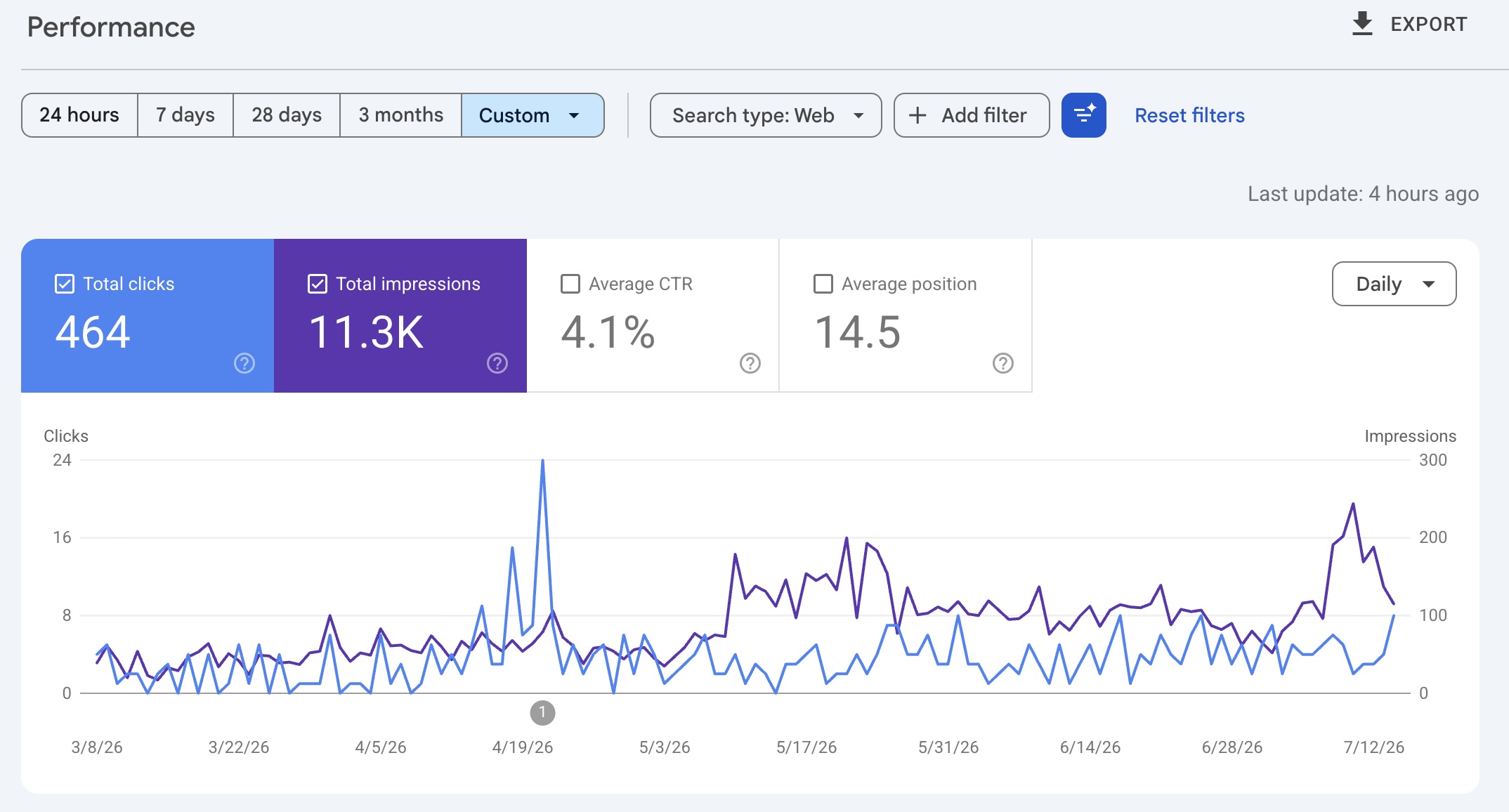
Straight from Search Console: 11.3K impressions and 464 clicks over the window, at a 4.1% CTR and an average position of 14.5. The shape is the point — impressions (the purple line) sit low and flat through March and April, then lift into a noticeably higher band from early May and hold there through the summer. That inflection lines up with switching the pipeline on at the end of April.
What failed or remained difficult
The most instructive failure: an early run used a cached snapshot of the site's posts instead of checking live WordPress, missed an already-published article, and started drafting a near-duplicate. The pipeline's cannibalisation check caught it mid-run, and the draft was merged into the existing post as a refresh instead — canonical URL and inbound links preserved. The rule that came out of it: never trust a cached inventory; always check the live system.
Reusable lesson
Separate planning from execution, and put the human gate between them. Reviewing a month of intentions takes ten minutes; un-publishing a month of mistakes takes much longer.
Resources
All five skills and the scheduled tasks behind this pipeline are published — sanitised — in the SEAR Plugs optimisation repo, with an "adapting this for your brand" guide. Each skill is triggered by natural language in Claude Cowork; the scheduled tasks run on the cadences noted.
Skills
keyword-researcher— say "find keywords for surfer's ear"; pulls the Search Console baseline and expands seeds, including the mandatory EU-language pass.content-calendar-planner— run it after research ("plan next month's content") to map the surviving keywords onto publish dates incontent-calendar-active.xlsx.seo-blog-writer— "write a post on <keyword>"; analyses the live SERP and creates a WordPress draft with meta title and description in place.seo-site-auditor— "audit the site"; the 28-rule health check that routes fixes back to the writer and product optimizer.product-seo-optimizer— "optimise product pages"; rewrites WooCommerce copy against the product fact sheet.
Scheduled tasks
monthly-content-planning— monthly; runs the two planning skills and feeds the writer.write-blog-draft— Mon & Thu 08:00; writes exactly one due post as a draft.weekly-draft-review-email— Fri 09:00; emails the week's drafts with edit links — human gate #2.